Welcome to Advent.
And welcome to a brand-new lectionary year: Year B, to be exact… the year of Mark’s gospel. What do we know about Mark’s version of the Good News of Jesus Christ? Well, we know that that’s how he begins his gospel narrative: “The beginning of the good news of Jesus Christ, the Son of God” (Mark 1:1). There is no birth narrative, as there is in both Matthew and Luke. There is no lofty, poetic prologue, as there is in John’s Gospel: “In the beginning was the Word…” (John 1:1). Nope. Just the story of the beginning as Mark knew it: something about a messenger sent to prepare the way… and a baptism of repentance. But we’ll get to all of that next week. For now, it’s enough to know that Mark’s gospel is the shortest… just about two-thirds the length of the other two synoptic gospels… only 16 chapters, versus 28 and 24 from Matthew and Luke, respectively. And not only is there no birth narrative, in the earliest-known version of Mark’s gospel, Jesus makes no post-resurrection appearances. The gospel writer closes his narrative simply with the discovery of the empty tomb… and angels… and a promise that Jesus would meet the disciples in Galilee, where they would be sent forth to spread “the sacred and imperishable proclamation of eternal salvation” (Mark 16:8b). Mark sometimes reminds me of old Joe Friday on Dragnet… “Just the facts, ma’am… just the facts.”
Biblical Scholars are pretty sure that Mark’s gospel was the first one written… sometime around 66-70 AD. Matthew and Luke’s narratives first appear around 80(ish) AD, and John’s right on the cusp of the first and second centuries. Matthew and Luke both used Mark’s narrative as the basis for their own… and here’s a funny thing: Mark’s Greek apparently wasn’t all that good. Matthew and Luke both had to correct Mark’s grammar as they went… though not as much as my Greek professor in seminary had to correct mine. Until recently, many scholars thought that “Mark” could have been John Mark, one of Peter’s protégés in the Jerusalem Church, who would eventually found the Church in Alexandria (Egypt)… but now they’re not so sure. There are a lot of folks who know a lot more than about all this than I do… and there is plenty of reading material out there on the topic… so I’ll leave it to you to read up on it—if you want. But for our purposes today, let’s just say that we can’t be sure precisely who wrote Mark’s gospel, only that he was likely neither a Jew nor an educated Greek… but probably a gentile living outside of Palestine, and also that he wrote for a gentile audience. And, as you’ll see as we work our way through Mark’s gospel over the next year, Mark’s Jesus is predisposed to be a “man of action,” an exorcist, healer and miracle worker… the Son of God who wants to keep his divinity a secret, a teacher whose parables could be maddeningly opaque, and a messiah who adopted the role of “suffering servant,” willing to lay down his life to bring about the advent of the Kingdom of God. All good stuff.
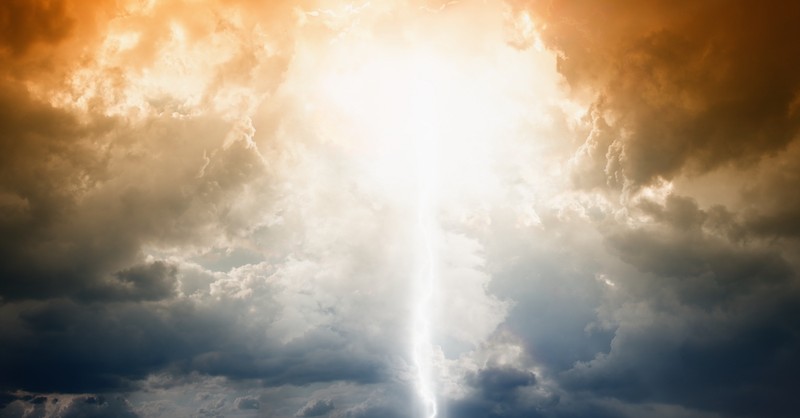
And it’s good context for our Gospel passage today, which crops up pretty late in Mark’s narrative. Jesus is in Jerusalem, near the end of his earthly ministry, talking about the end of the world. At that time, he said, the faithful would need to flee to the mountains. There would be not a moment to spare! Woe be to those who are pregnant or nursing infants, especially if the end comes in the winter… “For in those days there will be suffering, such as has not been from the beginning of the creation that God created until now, no, and never will be” (Mark 13:19). False messiahs would appear and try to lead people astray, but those who remained faithful to the real Messiah would be saved. They would see “‘the Son of Man coming in clouds’ with great power and glory . . . angels will gather his elect from the four winds, from the ends of the earth to the ends of heaven. (vv. 26-27). What a magnificent, terrible day that will be.
When Jesus speaks of “the Son of Man coming in clouds…” he is recalling the words of the Prophet Daniel who prophesied in Judah from around 605 until around 536 BC… right in the middle of the worst period of history the Jews had ever known. They’d been overrun by the Babylonians, their Temple had been destroyed, and all the people sent into exile. God’s rebellious people were reaping what they had sown. But even so, in the midst of all the violence and turmoil, when the last remnants of the glorious kingdom built by David and Solomon were being trampled into the dust, Daniel prophesied words of awesomeness and hope to a faithful remnant of God’s people in their time of need. He said the Son of Man, the Messiah, would return to save his people, and that he would be given “dominion and glory and kingship… and that all peoples, nations, and languages should serve him. His dominion would be an everlasting dominion that would never pass away. His kingship would never be destroyed” (Daniel 7:13b-14). And five-hundred years later Jesus, like Daniel, is prophesying the fate of the latest generation of God’s rebellious people. And his message for us today is as timely and important as it was to his disciples two-thousand years ago: Be watchful; keep awake, for the Son of Man is coming at an unexpected hour.
During my time in policing, we would typically refer to the span of hours we were assigned to work in a day as a “watch.” 7a to 3p was day watch, 3-11 was evening watch and 11p-7a was morning watch. Or sometimes it was just first watch, second watch, and so forth. The point is that we consciously avoided using the term “shift.” That sounded too much like working on an assembly line, I guess. We weren’t on shift… we were on watch. Standing watch was a routine, yet sacred responsibility. You were only one person, but you were serving on behalf of many. And few things would land you in as much hot water as sleeping on watch. Falling asleep not only placed the mission in jeopardy, but also the health and safety of people who were counting on you. They say that police work is 99% routine and 1% panic… and that’s true, and you never knew when you’d be called upon to respond to a crisis. So, you stayed awake. And you helped others who were on watch with you stay awake, too. After all, the chain is only as strong as its weakest link.
And as important as this sort of temporal readiness can be, the spiritual readiness to which Jesus is calling us in today’s Gospel passage is infinitely more so—because that sort of readiness will determine how we spend eternity. Our Messiah has come and opened the scriptures to us through his words and actions (cf. Luke 24:32). He has told us everything we need to know. Now it’s up to us to repent of the willfulness and self-indulgence that dogs our days as it did those of the Jewish people in Old Testament times. We must daily recommit ourselves to loving God and our neighbor, to being good stewards of the vineyard, and bringers of the Kingdom that will surely come.
The season of Advent offers us an opportunity to reflect on the mystery of the Incarnation: What kind of God would send his only Son to live among us… and die among us… to show us the way to eternal life? And why? It’s a chance for us to take stock of where we are… and assess ourselves honestly with regard to where we need to be in our relationship with our Creator. What if the Son of Man was to come this evening? Or tomorrow? Would we be ready for the New Beginning foretold by Jesus in our Gospel lesson this morning? That magnificent and terrible day when the Son of Man will come in clouds… with great power and glory… the day God’s kingdom will break upon this world and change everything, forever.How are you preparing for that day of all days? Stand your watch. Keep awake. Much depends upon your diligence and preparation. Don’t let the Second Coming pass you by.
 A few words from Father Kemper